/ DEPT 05: STRUCTURAL STABILIZATION
Your property isn't just land; it's an investment in stability.
Most contractors view a retaining wall as a decorative border. At The Muscle, we view it as a critical piece of civil infrastructure. In the challenging terrain of Paducah, Murray, and Mayfield, a wall that "looks good" isn't enough. It has to perform under the immense pressure of Kentucky’s heavy clay soils and unpredictable weather patterns.
If you are dealing with a failing timber wall, a sliding hillside, or a new construction project that requires significant grade changes, you need more than a "landscaper." You need an engineered solution. We specialize in high-capacity segmental retaining wall systems designed to stabilize slopes, maximize usable square footage, and protect your foundation for decades.
For homeowners, that means the wall is not just built to look clean on day one. It is built to manage heavy soil loads, move water correctly, and hold up through the expansion and contraction cycles that are common in Western Kentucky.

The Reality of Retaining Wall Failure in Western Kentucky
In Western Kentucky, the earth is working against you. The predominant soil type across Paducah and Benton is a dense, highly plastic clay. This material is the primary cause of retaining wall failure for one simple reason: it is expansive.
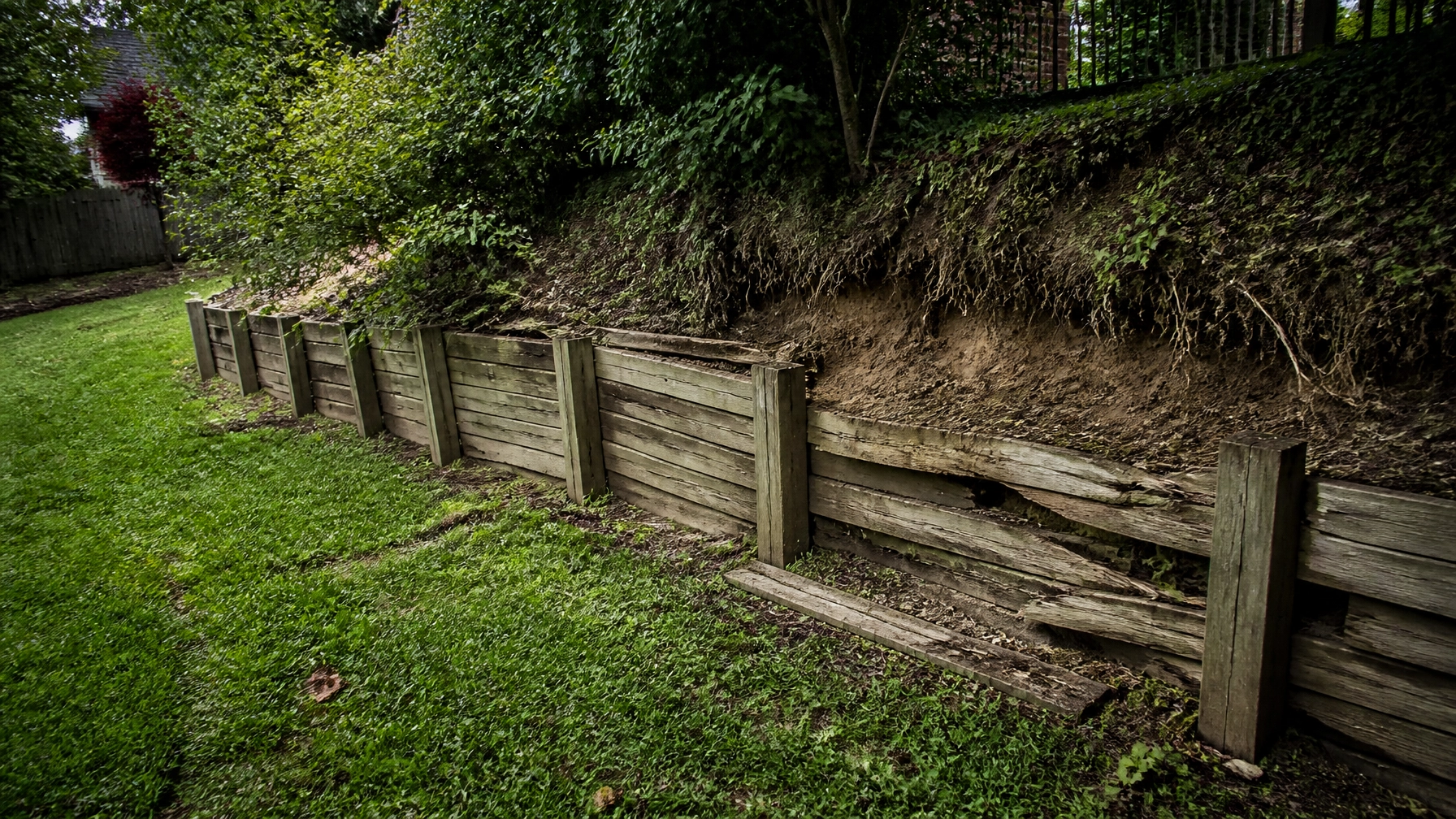
When it rains, our clay absorbs water like a sponge, expanding in volume and exerting thousands of pounds of "hydrostatic pressure" against the back of your wall. When it dries, it shrinks, creating voids and internal shifts. This constant cycle of expansion and contraction will snap a timber wall like a toothpick and cause unreinforced concrete to crack and lean.
Common Failure Signs:
- Leaning or "Tipping": The wall is physically moving forward at the top, a clear sign that the lateral earth pressure exceeds the wall's structural capacity.
- Bulging (The "Belly"): Individual blocks or sections are pushing out, often indicating a lack of internal reinforcement or poor backfill.
- Clogged Drainage: Water pooling at the base or weeping through the face of the stone (efflorescence) means your site drainage is failing.
- Sinkholes at the Top: This often signals that the "fines" (small soil particles) are washing out from behind the wall because a filter fabric was either omitted or installed incorrectly.
/ SERVICE 02: EROSION CONTROL & DRAINAGE
Managing the Invisible Killer: Hydrostatic Pressure
Drainage is not an "add-on" feature, it is the most critical component of any retaining wall. More walls fail because of water than any other factor. In Western Kentucky, where a single storm can drop inches of rain in hours, your wall must be a sieve, not a dam.

Every wall we build includes a comprehensive site drainage strategy:
- The Drainage Zone: We install a minimum of 12 to 24 inches of clean, angular #57 stone directly behind the wall units. This creates a low-resistance path for water to drop straight down rather than pushing against the blocks.
- Perforated Pipe Systems: A 4-inch perforated drain tile is placed at the bottom of the drainage stone, sloped at a minimum of 0.5% to "daylight" (exit) at a safe location.
- Geotextile Separation: We wrap the drainage stone in a professional-grade filter fabric. This prevents the native Paducah clay from migrating into and clogging your clean stone, ensuring the system works for 30+ years, not three.
From a homeowner standpoint, this is what keeps a wall from becoming a water trap. If drainage is skipped or undersized, hydrostatic pressure builds fast, and even a wall with expensive materials can start to lean, bulge, or fail early.

Engineered Strength: Geogrid Reinforcement
For any wall exceeding three feet in height, or walls supporting a "surcharge" like a driveway or a pool, gravity alone isn't enough to hold the earth back. This is where geogrid reinforcement becomes mandatory.
Geogrid is a high-tenacity polyester mesh that we "sandwich" between the courses of your segmental retaining wall systems. It extends several feet back into the hillside, effectively pinning the wall to the earth it’s holding up. By turning the soil itself into a reinforced structural mass, we can build taller, safer walls that stand the test of time.
In simple terms, geogrid helps the wall and the soil work together as one system. That is a major difference between a decorative wall and an engineered retaining wall that is meant to handle real structural loads.

The Foundation: Why Base Preparation is Non-Negotiable
You can buy the most expensive stone in the world, but if you set it on a weak foundation, it will fail. At The Muscle, we go beyond the industry minimums for Western Kentucky’s soft subgrades.
- Over-Excavation: We dig down to "virgin" soil, removing all organic material and loose fill.
- Thickened Bases: While many "pros" use 4 inches of gravel, we typically specify an 8-inch compacted stone base.
- Industrial Compaction: We don't just "tamp" the dirt. We use reversible plate compactors to ensure the base is rock-solid and level.
- Embedment: A portion of the wall must be buried underground to prevent the "toe" from sliding out. We follow strict engineering ratios to ensure your wall is anchored into the landscape.
Retaining Wall Repair vs. Retaining Wall Replacement
Many homeowners in Murray and Mayfield ask if their existing wall can be saved. Here is our "no-nonsense" assessment:
When to Consider Retaining Wall Repair:
- Minor settling of the top cap stones.
- Small areas of localized erosion at the ends of the wall.
- Minor aesthetic chips in the stone.
When Retaining Wall Replacement is Mandatory:
- Timber/Railroad Tie Decay: If your wood wall is rotting, there is no "fix." The structural integrity is gone.
- Significant Leaning: If the wall is more than a few degrees out of plumb, the center of gravity has shifted too far to be safely stabilized.
- Foundation Cracks: In poured concrete walls, structural cracks often mean the internal rebar has corroded or the footing has snapped.
Replacement using modern Unilock retaining wall systems is almost always the more cost-effective long-term solution. It eliminates the maintenance of wood and the "brittleness" of poured concrete.

/ PRODUCT 01: UNILOCK RETAINING WALL SYSTEMS
We choose to install Unilock retaining wall systems because they represent the pinnacle of hardscape engineering. These aren't your big-box store garden blocks.
- Dimensional Accuracy: Every block is engineered to tight tolerances, ensuring perfectly level courses.
- High-Strength Concrete: With PSI ratings far exceeding standard poured concrete, these blocks resist the freeze-thaw cycles of Kentucky winters without crumbling.
- Aesthetic Versatility: From the rugged, natural look of U-Cara to the massive structural capacity of Concord Wall, we can match the architectural style of any home in Western Kentucky.
- Integrated Steps & Lighting: Our systems allow for seamless integration of custom stone steps and low-voltage lighting to turn a structural necessity into a focal point.
Why Choose "The Muscle" for Your Paducah Project?
We don't do "hidden add-ons" and we don't do "good enough." When you hire us for a project in Western Kentucky, you are getting:
- Transparent Upfront Pricing: We put a real number on the project from day one.
- Professional Dirt Work: Our expertise in grading and dirt work ensures the entire site is managed, not just the wall itself.
- Reliability: We show up, we communicate, and we stand behind the structural integrity of our work.

FAQ: Structural Retaining Walls in Paducah
Q: Do I need a permit for my retaining wall?
A: In many parts of Western Kentucky, walls over 4 feet in height require a building permit and, in some cases, an engineer's seal. We handle the technical coordination to ensure your project is compliant.
Q: How long does a segmental wall last?
A: When built with proper geogrid reinforcement and site drainage, a segmental wall from Unilock is designed for a 50+ year service life.
Q: Can you build a wall on a steep hill?
A: Yes. This is where we excel. We use tiered (terraced) designs to break up the pressure and create flat, usable yard space where there was once only a "lost" slope.
Q: Is a stone wall better than a poured concrete wall?
A: Yes. Segmental walls are "flexible" systems. They can handle the slight movements of Kentucky clay without cracking, whereas poured concrete is rigid and prone to catastrophic failure if the ground shifts.
Secure Your Property Today
Don't wait for the next heavy rain to see if your hillside holds. Whether you need a massive structural retaining wall replacement or a new engineered installation to reclaim your backyard, we are ready to put in the work.
We provide zero-obligation site consultations across Paducah, Murray, Mayfield, and Benton. We'll look at your grade, your soil, and your goals, and give you a no-pressure plan to stabilize your land for good.
Contact The Muscle for a Structural Consultation
Build a More Functional Property
If you're dealing with water issues behind your structure, check out our Western Kentucky Drainage Guide. Planning to turn your slope into a usable space? See our Murray, KY Paver Patio Guide.