
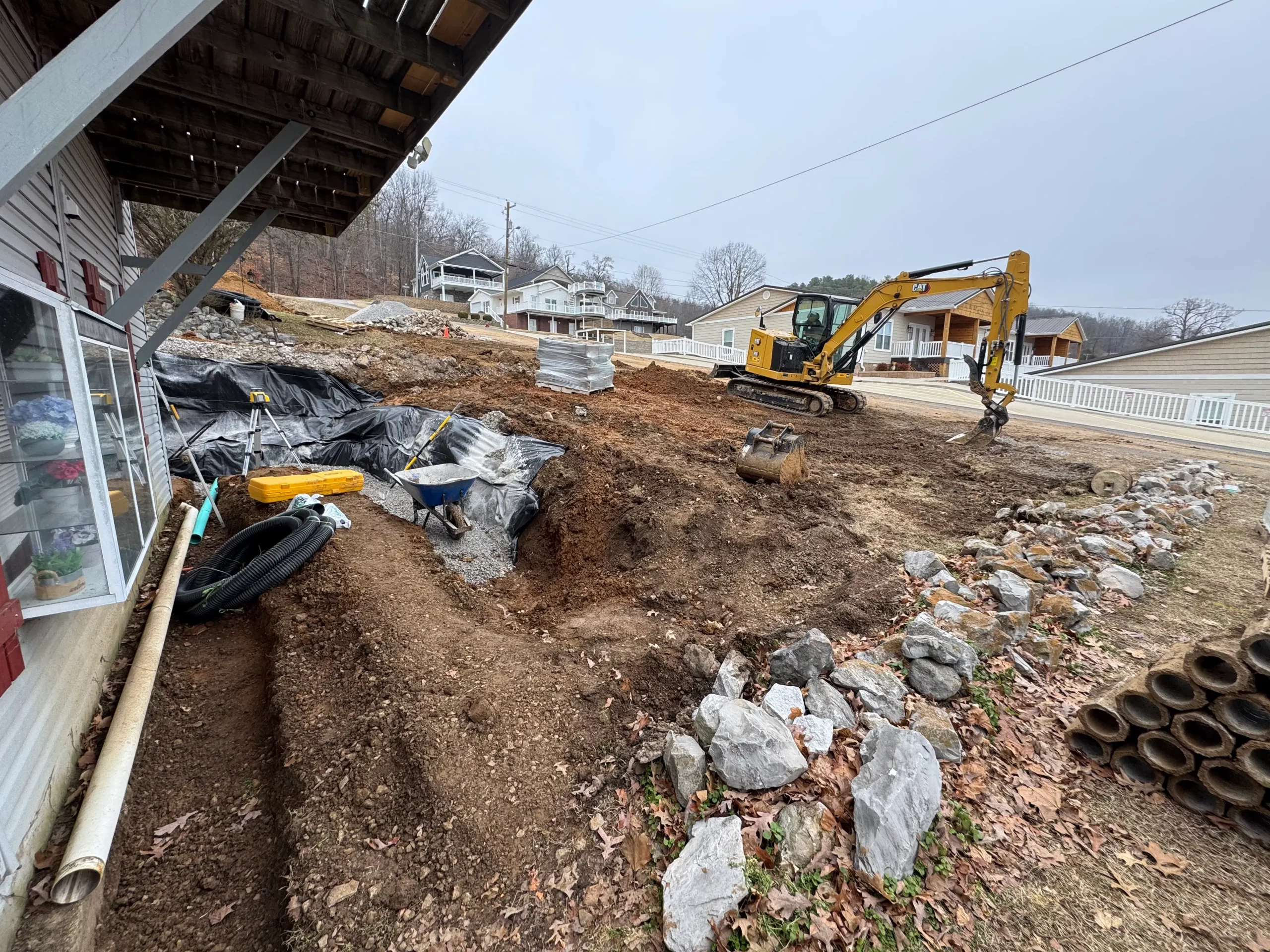
Standing water is not just an eyesore. It can kill your lawn, wash out mulch, damage hardscapes, attract insects, and send moisture toward your foundation.
If your yard stays soggy days after a storm, your downspouts dump beside the house, or a DIY French drain stopped working, the problem may be deeper than one puddle. A drainage system has to collect water, move it at the right speed, and discharge it somewhere that can handle the flow.
That is where a qualified drainage contractor near me can make the difference.
The Muscle serves homeowners and property owners across Western Kentucky, Southern Illinois, and Northern Tennessee. We look at the whole property: not just the wet spot: and build practical landscape drainage solutions around your grading, soil, structures, and long-term goals.
/ Dept 01 : The Problem
Water Finds the Weak Point
Your yard may be telling you exactly where the drainage system has failed.
Common warning signs include:
- Standing water after ordinary rain
- Muddy or thinning grass
- Erosion channels along slopes
- Water collecting beside patios or driveways
- Basement-area moisture
- Downspouts discharging against the foundation
- A French drain that fills but does not empty
- Soil that stays soft or saturated for days
Here are 10 common causes: and what a professional drainage installation may need to correct.
/ Dept 02 : Diagnosis
1. Heavy Clay Soil Is Blocking Infiltration
Western Kentucky and surrounding areas commonly include dense clay soil. Clay holds together tightly, leaving limited space for water to move through.
That means simply digging a hole or burying a pipe may not solve the issue. Water can collect above the clay layer, surround the pipe, and remain trapped underground.
In heavy clay, effective drainage usually means moving water to a reliable outlet rather than expecting the soil to absorb a large volume. The system may require clean rock, geotextile fabric, correct pipe slope, and a discharge point that is lower than the problem area.
2. The Yard Is Graded Toward the House
Poor grading is one of the most common reasons a yard drainage system fails. If the surface naturally slopes toward your home, water will continue to follow that path: even if a drain has been installed nearby.
A drainage contractor may need to reshape the yard with dirt work and grading so water moves away from the foundation and toward a controlled collection point.
A buried pipe cannot fully correct a surface that sends water in the wrong direction. The grade has to support the drainage plan.

3. The Drain Has No Engineered Outlet
A pipe is not a drainage solution if it has nowhere useful to send the water.
This is where many low-cost or DIY drainage projects break down. The pipe may collect water correctly, but the outlet is missing, too high, buried in clay, or connected to an area that is already saturated.
A properly planned system may use:
- Daylighting, where the pipe exits openly at a lower elevation
- A pop-up emitter in a suitable discharge area
- A controlled outlet to a ditch or approved drainage point
- A properly sized dry well where site conditions allow
- A solid pipe run carrying water away from the collection area
The outlet must be evaluated before installation begins. Otherwise, the trench can become an underground holding tank.
4. The French Drain Has the Wrong Slope
French drain installation depends on more than digging a trench and placing perforated pipe inside it. The pipe needs a consistent fall so collected water can move toward the outlet.
If the line has flat sections, dips, or reverse slope, water can sit inside the pipe. During a heavy storm, the system may fill faster than it can drain.
Professional installation should account for the existing elevations, the location of the collection area, and the final discharge point. The exact slope depends on the property and system design, but the basic requirement is straightforward: water needs a continuous path downhill.
5. The Outlet Pipe Is Clogged or Undersized
Leaves, mulch, sediment, roots, and clay fines can restrict a drainage line. An outlet may appear to be installed correctly but still move very little water.
The pipe may also be too small for the roof area, driveway, patio, or slope feeding it. A line that handles light rain may fail during a major storm.
Before recommending a repair, a contractor should identify what is entering the system, how much water is involved, and where the restriction occurs. Sometimes cleaning is enough. Other times, the outlet needs to be rebuilt with larger or better-suited components.
6. The Catch Basin Is in the Wrong Location
A catch basin works by collecting surface water at a low point. If it is installed higher than the puddle, surrounded by a poorly sloped surface, or covered with sediment, water will simply flow around it.
The basin should be positioned where water naturally concentrates: or where grading intentionally directs it. The grate also needs regular maintenance so leaves and debris do not block the inlet.
A drainage contractor can determine whether the existing basin is placed correctly, connected to a functioning outlet, and sized for the area it serves.
7. The Gravel and Geotextile Fabric Were Installed Improperly
A French drain needs a path for water to move through the trench without filling with soil. That generally means using clean, appropriately sized rock around the perforated pipe and separating the drainage materials from surrounding clay with suitable geotextile fabric.
When fabric is missing, poorly placed, or clogged with soil, clay can migrate into the rock and pipe. The voids disappear. The drain loses capacity.
Material selection matters. So does installation. The fabric should be used to keep surrounding soil from contaminating the clean rock: not as a shortcut that seals the pipe or restricts water movement.
8. The Trench Is Too Shallow, Narrow, or Short
A small trench may not intercept enough water to solve a large drainage problem. If it stops before the wet area, sits above the saturated layer, or has very little rock around the pipe, it may provide only temporary relief.
The correct trench depth and width depend on the site. A foundation drainage problem, lawn low spot, driveway washout, and hillside erosion issue may all require different designs.
The goal is not to install the biggest system possible. It is to install enough collection capacity, storage space, and outlet performance to handle the actual water moving across your property.

9. Downspouts Are Dumping Water in the Wrong Place
Your roof can send a surprising amount of water into a small area. If downspouts discharge directly beside the foundation or into a low part of the lawn, they may be responsible for recurring moisture and erosion.
Downspout extensions can help, but they are not always enough. Depending on the property, a better solution may include buried solid pipe, a catch basin, a pop-up emitter, or a separate outlet run.
The important point is to control roof runoff before it becomes a foundation or lawn drainage problem.
10. The DIY Drainage System Was Built Without the Whole Site in Mind
DIY drainage projects often focus on the visible symptom: one puddle, one muddy strip, or one downspout.
But water does not stop at property features. It travels across grades, under walkways, around retaining walls, and through compacted soil. A drain installed without checking elevations and flow paths can redirect the problem instead of solving it.
A professional assessment should consider:
- Where the water starts
- How much water is moving
- Which surfaces contribute runoff
- Where the soil allows or prevents infiltration
- Where water can be discharged safely
- How the system will be maintained
That is the difference between burying a pipe and building a drainage system.
/ Dept 03 : The Fix
Build the Water Path First
The right landscape drainage solutions may combine several methods rather than relying on one product.
Depending on your property, a drainage installation could include:
- Grading and leveling to move surface water away from structures
- Catch basins to collect water at low points
- French drains to intercept subsurface and surface moisture
- Solid outlet pipe to carry collected water away
- Pop-up emitters to release water in a controlled location
- Daylighting to discharge water openly at a lower elevation
- Geotextile fabric and clean rock to protect the system from clay and sediment
- Downspout drainage to keep roof runoff away from foundations
- Swales or shaped drainage paths to guide water across larger yards
- Dirt work and rebuilding where existing grades or failed installations must be corrected
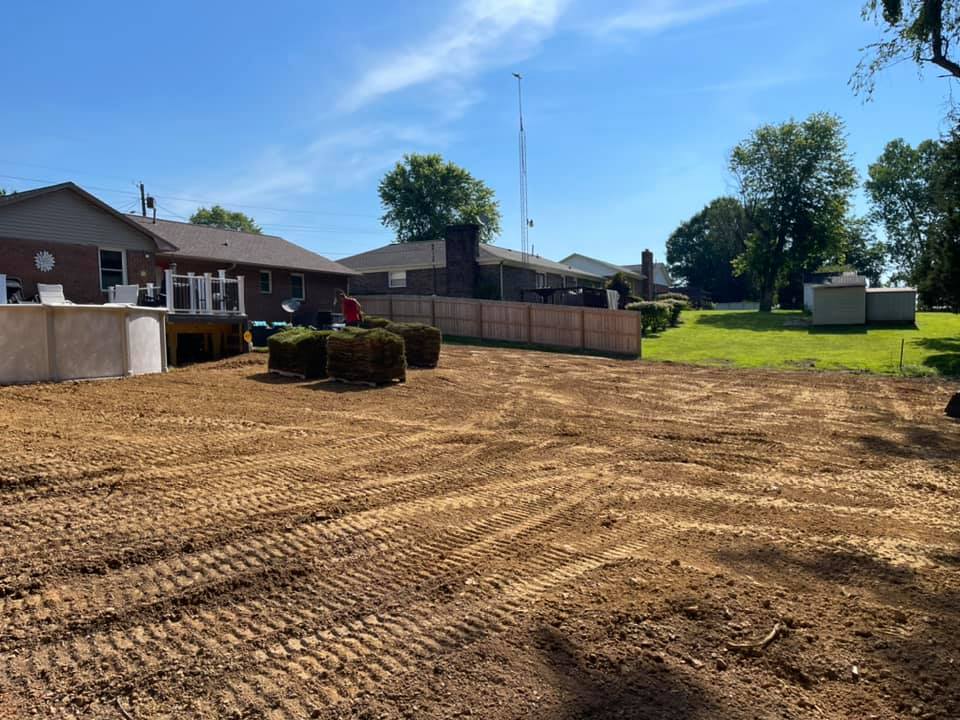
At The Muscle, we stay involved from the first walkthrough through the final cleanup. We are fully insured, professionally equipped, and personally accountable for the work we perform. Our team handles grading, excavation, culvert and drainage installation, material spreading, and related landscape improvements.
/ Dept 04 : The Investment
What Does Drainage Installation Cost?
The cost of drainage installation depends on the size of the problem and the work required to correct it.
A simple downspout extension is very different from a full French drain installation involving excavation, grading, catch basins, geotextile fabric, clean rock, outlet construction, and landscape restoration.
The main cost factors include:
- Length and depth of the trench
- Soil conditions, especially heavy clay
- Access for equipment
- Number of downspouts or collection points
- Required pipe size
- Distance to the outlet
- Whether grading or excavation is needed
- Removal and replacement of lawn, gravel, concrete, or landscaping
- Erosion control or retaining work
You deserve a clear scope and an honest number before work begins. We do not rely on surprise add-ons. We will walk the property, discuss your goals, explain the practical options, and put a real number on it.
/ Dept 05 : The Local Call
Need a Drainage Contractor Near Me?
If you are searching for a drainage contractor near me, you are probably not looking for another generic tip. You want the water handled correctly: and you want to know what the work will cost.
The Muscle is based in Murray, Kentucky, and serves Western Kentucky, Southern Illinois, and Northern Tennessee, including Murray, Paducah, Mayfield, and surrounding communities.
We can assess the issue, identify the failure point, and recommend a focused solution instead of automatically replacing everything.
For background on our dirt work and drainage-related capabilities, visit our Dirt Work service page. You can also review our broader landscaping services and recent project gallery.
/ Next Step
Request a Bid. No Pressure.
Tell us where the water stands, how long the problem has existed, and what you have already tried. Include photos if you have them.
Call The Muscle at (270) 248-9790 or request a bid online.
We will take a look, talk through the options, and give you a straightforward next step. No pressure. No obligation.
Need a resource for planning or comparing project details? Contact us and request the Contractor Packet. We will help you understand the scope before you commit to the work.