
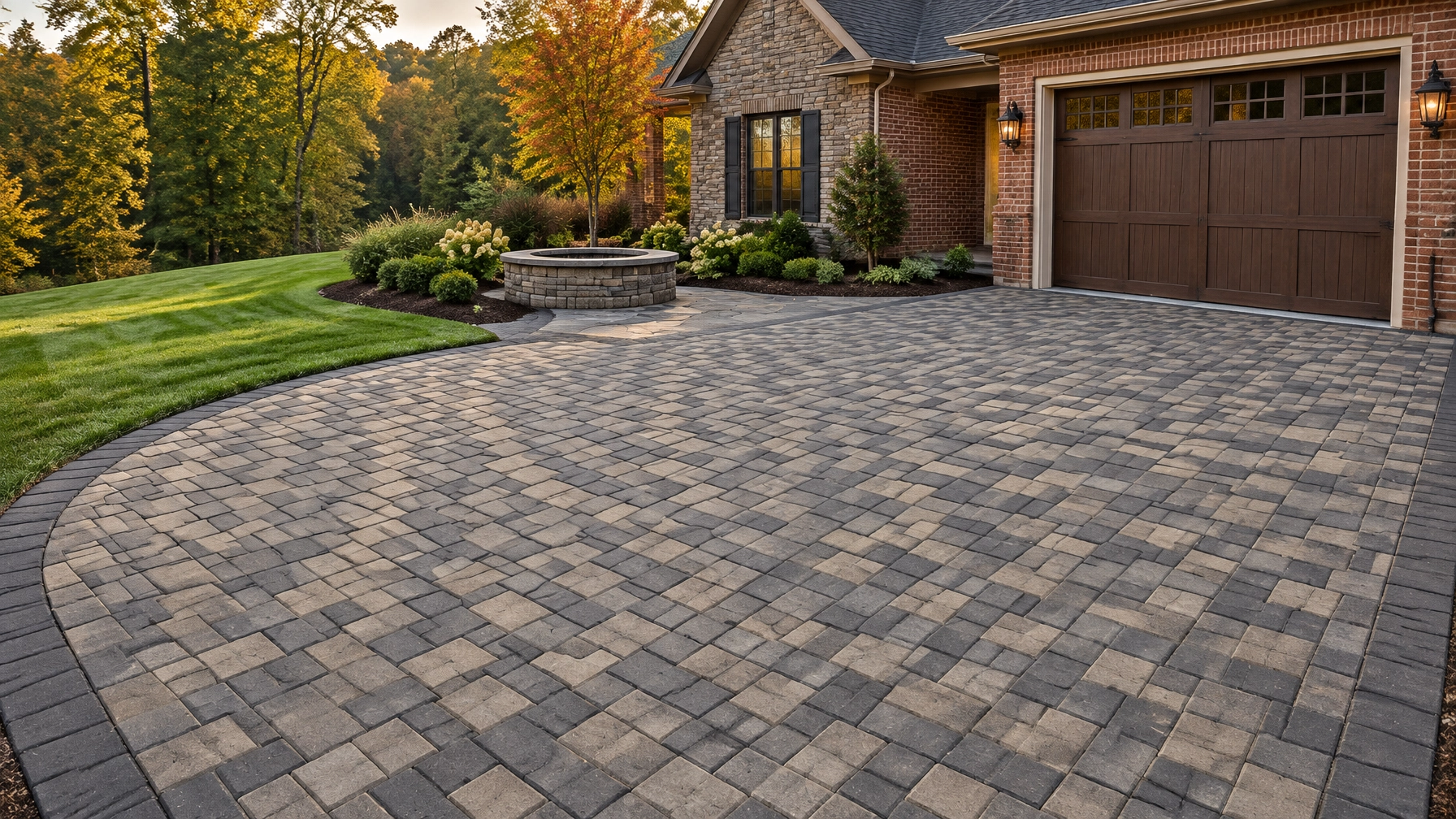
Your driveway takes more abuse than almost any other hardscape on your property.
It carries daily traffic, delivery trucks, work vehicles, and sometimes a snowplow. It absorbs summer heat, heavy rain, de-icing salt, and repeated freeze-thaw movement. When Western Kentucky clay soils shift underneath it, the driveway has to respond without losing its grade or falling apart.
That is why homeowners in Paducah, Mayfield, Murray, Benton, Calvert City, Kentucky Lake, and Lake Barkley often compare two options: paver driveway installation or poured concrete.
Both can be built well. Neither performs well when the base, drainage, or installation is treated as an afterthought.
Here is the honest comparison.
Request a Bid from The Muscle for a driveway evaluation and a clear project number based on your property.
/ Dept 01: The Kentucky Problem
The surface is only as strong as what is underneath it.
Western Kentucky presents a difficult combination for driveways: clay soils, changing moisture levels, heavy rainfall, and winter freeze-thaw cycles.
Clay expands when it absorbs water and contracts as it dries. If water remains trapped beneath a driveway, freezing can push sections upward. When the ground settles again, the surface may not return to its original position.
That movement affects both concrete and pavers. The difference is how each system responds.
A poured concrete driveway is a rigid slab. When the soil moves unevenly, the slab has limited ability to flex. It may crack through the field, separate at control joints, settle at the edges, or develop surface damage from moisture and de-icing products.
A paver driveway is a flexible, modular system. Individual units can move slightly with the base and remain interlocked when the installation is engineered correctly.
The key phrase is when the installation is engineered correctly. Pavers are not a shortcut around poor drainage or weak base preparation.

/ Dept 02, Poured Concrete
Concrete is practical, familiar, and not automatically the wrong choice.
Poured concrete remains a reasonable driveway material for many homeowners. It creates a smooth surface, works with a wide range of home styles, and can be installed efficiently when the site is accessible and the base is properly prepared.
Concrete may be the right call when:
-
Your budget favors lower initial investment.
A basic concrete driveway is often less expensive upfront than a fully installed paver system. -
You prefer a continuous, simple surface.
Concrete has clean visual lines and no individual joints between pavers. -
The site has stable, well-drained soil.
Good soil conditions reduce the movement that causes problems in rigid slabs. -
The driveway has a straightforward layout.
Simple access, moderate grades, and limited drainage complications can make concrete a sensible solution. -
You are comfortable with the repair limitations.
Concrete can last for years when properly designed, placed, cured, and maintained. However, cracking remains a possibility in our climate even when the work is done correctly.
Control joints help direct where concrete is likely to crack. They do not make the slab immune to cracking. Soil movement, water beneath the slab, improper curing, and freeze-thaw cycling can still create damage outside the planned joint lines.
De-icing salt can also contribute to scaling and surface deterioration, particularly when concrete is not properly specified, cured, or protected. Concrete should be designed for local winter conditions rather than treated as a one-size-fits-all product.
/ Dept 03: Paver Driveways
Pavers earn their cost through flexibility and repairability.
An engineered paver driveway is built in layers. The existing material is excavated, the subgrade is addressed, and a compacted aggregate base is installed at the depth required for the site and expected loads.
The finished surface depends on more than the paver itself.
A reliable installation typically includes:
-
Proper excavation.
Weak or unstable material must be removed rather than buried beneath the driveway. -
A compacted aggregate base.
The base distributes vehicle loads and provides a stable working platform. It should be installed and compacted in controlled lifts, not dumped in one thick layer. -
Accurate grading.
The driveway needs positive drainage away from the garage, foundation, and low areas of the property. -
Secure edge restraint.
Without strong edges, pavers can spread or migrate under repeated vehicle loading. -
Tight, properly filled joints.
Polymeric sand can help stabilize joints and reduce weed growth and water intrusion when installed according to product requirements. -
A pattern suited to vehicle traffic.
The design should account for turning movements, heavy loads, and the way vehicles enter and leave the property.
The visible pattern matters. The invisible construction matters more.
As a Unilock Authorized Contractor, The Muscle works with manufacturer-supported products and installation practices for hardscape projects. That does not eliminate site-specific decisions, but it adds a useful standard when you are comparing hardscaping contractors.

/ Dept 04: The Real-World Comparison
Repairability
This is one of the clearest differences.
A cracked concrete slab is usually patched, saw-cut, or replaced. Repairs may remain visible, and one damaged area can be a sign that the surrounding base or drainage needs attention.
Pavers can be lifted and relaid. If a section settles near a downspout, utility trench, or soft spot, the affected units can be removed, the base corrected, and the same pavers installed again.
That does not mean pavers never move. It means movement can often be corrected without demolishing the entire driveway.
Heavy trucks
Both materials can support heavy vehicles when designed for the intended use.
Concrete depends heavily on slab thickness, reinforcement details, concrete mix, control joints, and the quality of the supporting base. A driveway used by work trucks, RVs, trailers, or delivery vehicles should not be built to the same assumptions as a light residential drive.
Pavers distribute loads through the interlocking surface and aggregate base. A professional should still account for the weight, turning patterns, and frequency of heavy traffic before determining the installation details.
If a dump truck will routinely use the driveway, say so before the bid is prepared.
Snowplows
A well-built paver driveway can handle snow removal, but the details matter.
Edges should be secure and transitions should be flush. Loose or uneven pavers can catch a plow blade. Properly filled joints and a stable surface reduce that risk.
Concrete is simple to plow because it is continuous. However, a plow blade can still damage a surface if it digs into a raised section or catches deteriorated concrete.
For either material, communicate the intended snow removal method before construction. That is especially important around garage thresholds, drainage grates, curbs, and transitions.
De-icing salt
Concrete can suffer from scaling and surface deterioration when exposed to repeated salt and freeze-thaw cycles. Salt should be used carefully and according to the material manufacturer’s recommendations.
Quality concrete pavers are dense and designed for exterior use, but they are not indestructible. Poor drainage, weak joints, and improper cleaning practices can still create problems.
The best defense for either driveway is controlled water, proper construction, and sensible winter maintenance.
Curb appeal and resale
Concrete is clean and functional. Pavers provide more room for design.
You can use contrasting borders, multiple sizes, directional patterns, and colors that connect the driveway to the home’s brick, stone, walkways, or patio. A driveway that looks intentional can improve the first impression of the property.
That does not guarantee a specific resale return. It does give the property a more finished appearance and may help the driveway feel like part of the home rather than a leftover slab.
/ Dept 05: How Much Does a Paver Driveway Cost?
Plan for the site, not just the square footage.
A paver driveway usually requires a higher upfront investment than basic poured concrete. The reason is not simply the price of the pavers. The project includes excavation, aggregate, compaction, edge restraint, cuts, drainage, labor, access, and disposal.
A realistic planning range moves from straightforward to complex based on:
- Driveway size and width
- Existing asphalt or concrete removal
- Western Kentucky clay and subgrade conditions
- Required excavation depth
- Drainage corrections
- Slope and elevation changes
- Curves, borders, and specialty patterns
- Access for equipment and material delivery
- Expected truck, trailer, or RV traffic
- Connections to walkways, patios, or retaining walls
A simple replacement with good access and stable grades is a different project from a lakefront driveway with slope concerns, drainage challenges, and multiple transitions.
There is no responsible way to put one universal number on every property. Request a Bid, and The Muscle will evaluate the actual conditions before putting a real number on the work.
For related planning, see our guides on paver installation and paver patio costs in Paducah.
/ Dept 06, Which One Should You Choose?
Choose the material that matches your property and your expectations.
Poured concrete may be the right answer if you want a straightforward surface, have favorable site conditions, and are prioritizing initial cost.
Pavers may earn their cost if you:
- Plan to stay in the home long term
- Deal with shifting clay or recurring drainage problems
- Want easier localized repairs
- Use de-icing salt during winter
- Expect frequent heavy vehicle traffic
- Want stronger design integration with patios, walkways, or walls
- Care about replacing sections without removing the entire driveway
For Kentucky Lake and Lake Barkley properties, drainage deserves extra attention. Sloped lots and lakefront terrain can move water toward driveways, garages, foundations, or lower portions of the property. A paver driveway can be part of the solution, but only when the grade and drainage plan are handled from the beginning.
If water is already washing across your drive or collecting beside the garage, review our guide on common yard drainage problems before choosing a surface.
/ Next Step: Build It Once
Your driveway should be engineered for the ground it sits on.
The right driveway is not selected by color alone. It is selected by soil, drainage, traffic, maintenance expectations, and how the property needs to function.
The Muscle serves Western Kentucky, Southern Illinois, and Northern Tennessee with professional hardscape installation backed by honest communication and upfront pricing. We are a Unilock Authorized Contractor, and we focus on the base work and drainage details that determine whether a finished driveway stays dependable.
Request a Bid online or call (270) 248-9790. No pressure. We will look at the property, discuss your goals, and explain the practical options.
You can also review the Contractor Packet to learn more about our process and capabilities.